Domain Data API Security Review Checklist 2026: Evidence, Controls, and Vendor Questions
Security review for a domain data API should not be a late-stage paperwork exercise. It should prove that the API can collect trustworthy external-asset evidence, control access, report usage, and route findings without smuggling unsupported integration claims into the buying process.
The Real Security Question
Most domain, network, and certificate API evaluations start with coverage. Can the vendor return DNS records? Can it show WHOIS registration data? Can it inspect a certificate? Those questions matter, but they are not enough for a security approval.
The stronger question is operational: can your team use the API as a controlled evidence source for real decisions? A useful approval memo should show how API keys are issued, what gets logged, how usage is exported, which checks support the business workflow, and how exceptions move to the teams that can fix them. That matters for SOC 2 evidence, vendor reviews, incident response, domain portfolio governance, release validation, and security investigations.
This checklist is written for buyers who are already serious enough to compare vendors. It intentionally does not repeat a generic DNS, WHOIS, IP, or SSL explainer. It focuses on the review packet a security, compliance, platform, or procurement team needs before approving a paid API platform.
Verified Ops.Tools Surface for Review
The public Ops.Tools API reference verifies external endpoint families for DNS lookup, WHOIS data, IP details, SSL checks, HTTP header analysis, port scanning, API key management, and usage reporting. The pricing page describes one credit per API request, monthly plans starting at $6.99/month, bulk processing, webhook support, HTTPS encryption, usage logging controls, security review support, an auto-generated TypeScript SDK, and a Postman collection.
Use the API docs, pricing page, and relevant live tool pages as the approval sources. For exact request shape, the documented production base URL is https://api.ops.tools and authentication uses x-api-key or the documented query parameter. For product copy, keep claims tied to the visible pages instead of extrapolating from adjacent marketing language.
| Review area | Evidence to collect | Why it matters |
|---|---|---|
| Access control | API key creation, listing, update, and deletion | Security can assign ownership and rotate keys. |
| Usage visibility | Usage endpoint and downloadable usage export | Finance can verify plan fit and spike behavior. |
| External asset checks | DNS, WHOIS, IP, SSL, HTTP, and port results | Reviewers see the same facts operators use. |
| Automation | Webhook and bulk-processing behavior | Findings can move through internal workflows. |
| Security posture | HTTPS, usage logging controls, data handling notes | Approval does not depend on trust-by-demo. |
Step-by-Step Security Review Workflow
- Define the approving workflow. Pick one primary use case: recurring external asset evidence, domain portfolio review, release validation, vendor domain review, or incident enrichment.
- Build a controlled asset manifest. Include production domains, staging domains, expected DNS records, renewal owners, approved ASNs, certificate policy, critical headers, and port allowlists.
- Run checks from documented endpoints. Query DNS records, WHOIS registration data, IP ownership, certificate state, HTTP headers, and scoped port exposure with the same API key model you would use after approval.
- Save raw evidence and normalized findings. Keep the JSON response for auditability, then produce a compact result that says pass, warn, or fail for each asset.
- Validate usage reporting. Check whether the usage endpoints and downloadable reports give finance and security enough detail to understand consumption and outliers.
- Test automation wording. If alerts move through a webhook to your own Slack, Jira, SIEM, or SOAR workflow, document it as webhook-based or internally orchestrated unless the vendor documents a native integration by name.
- Write the approval memo. Include accepted risks, denied claims, plan recommendation, owner model, retry policy, evidence retention, and escalation path.
API Examples for the Evidence Packet
These examples use the public base URL and x-api-key authentication documented in the API reference. They are intentionally small. In a real review, run them from your own manifest and keep the response bodies with the approval record.
cURL: collect external asset evidence
API_KEY="$OPS_TOOLS_API_KEY"
BASE="https://api.ops.tools"
DOMAIN="example.com"

curl -sG "$BASE/v1-dns-lookup" \
  -H "x-api-key: $API_KEY" \
  --data-urlencode "address=$DOMAIN" \
  --data-urlencode "type=MX"

curl -sG "$BASE/v1-whois-data" \
  -H "x-api-key: $API_KEY" \
  --data-urlencode "domain=$DOMAIN" \
  --data-urlencode "parseWhoisToJson=true"

curl -sG "$BASE/v1-ssl-checker" \
  -H "x-api-key: $API_KEY" \
  --data-urlencode "domain=$DOMAIN"
TypeScript: normalize pass/fail evidence
type Asset = {
  domain: string;
  expectedMx: string;
  minCertificateDays: number;
};

const baseUrl = 'https://api.ops.tools';
const headers = { 'x-api-key': process.env.OPS_TOOLS_API_KEY ?? '' };

async function getJson<T>(path: string, params: Record<string, string>) {
  const url = new URL(path, baseUrl);
  for (const [key, value] of Object.entries(params)) {
    url.searchParams.set(key, value);
  }
  const response = await fetch(url, { headers });
  if (!response.ok) throw new Error(`${path} returned ${response.status}`);
  return (await response.json()) as T;
}

async function reviewAsset(asset: Asset) {
  const dns = await getJson<{ records?: string[] }>('/v1-dns-lookup', {
    address: asset.domain,
    type: 'MX',
  });
  const ssl = await getJson<Record<string, unknown>>('/v1-ssl-checker', {
    domain: asset.domain,
  });

  return {
    domain: asset.domain,
    mxObserved: dns.records ?? [],
    mxPolicy: (dns.records ?? []).some((record) => record.includes(asset.expectedMx))
      ? 'pass'
      : 'review',
    sslEvidence: ssl,
  };
}
Buyer Questions That Catch Weak Approval Packets
A security review should catch ambiguity before a vendor becomes operational infrastructure. Use these questions when evaluating Ops.Tools or any adjacent provider such as SecurityTrails, HackerTarget, IPinfo, or WhoisXML API.
| Question | Good answer | Risk signal |
|---|---|---|
| How is usage exported? | Documented usage endpoint or downloadable report. | Only dashboard screenshots. |
| How are alerts delivered? | Webhook or documented native integration. | A broad claim that every tool is integrated. |
| Can bulk checks be tested? | Representative manifest, retry policy, and timing notes. | A quota number without workflow evidence. |
| Are capabilities verified? | Claims match the live docs or repository. | Blog copy implies unsupported native features. |
How This Differs From a Generic Buyer Guide
A generic buyer guide asks which API has DNS, WHOIS, IP, and SSL data. A security review asks whether that data can survive procurement, audit, and incident scrutiny. The difference is evidence quality. If your team cannot explain who created the key, what was checked, how many requests were consumed, where failed checks went, and which claims were verified, the review is incomplete.
Tie the review to business workflows. Domain portfolio owners care about expiration tracking and registrar drift. SREs care about DNS record validation before release. Security teams care about unexpected ports, certificate changes, suspicious registration data, and enrichment during incidents. Compliance teams care that the evidence is repeatable and not just a screenshot from a one-off lookup tool.
Controls by Workflow
The same endpoint can carry different review requirements depending on the workflow. A DNS lookup used in a release gate needs deterministic expectations: record type, expected answer, acceptable cache window, and the failure behavior in CI/CD. A DNS lookup used in an incident needs a different control: preserve the observed response, timestamp, target, and requester so the result can be reconstructed later.
WHOIS and registration intelligence have a similar split. For domain portfolio management, the review should care about expiration tracking, registrar ownership, renewal owner, and how redacted fields are represented. For competitive research or brand protection, the review should ask whether the workflow labels public registration data carefully and avoids turning a weak clue into a hard attribution claim.
IP and ASN enrichment is useful for security triage, but it should not be treated as identity proof. A hosting provider, network owner, country, or city can add context to an investigation; it cannot prove who controls the traffic. That distinction matters in approval language. The security team should approve the API as an evidence source, not as an automatic verdict engine.
SSL checks belong in both operations and compliance workflows. A review packet should show certificate validity, expiry posture, and any chain or hostname evidence the workflow needs. If the team wants renewal alerts, define the alert path and thresholds. If the team wants compliance evidence, store raw output and a normalized summary together so auditors can see both the source and the interpretation.
Metric and Claim Hygiene
Security review is also where marketing claims should get cleaned up. During the live audit for this article, Ops.Tools pages consistently supported paid pricing from $6.99/month, API-key authentication, JSON responses, public OpenAPI documentation, usage reporting, bulk-processing language, webhook support, and the core DNS, WHOIS, IP, SSL, HTTP, and port-check endpoint families. Some performance, location, volume, and coverage claims vary by page or tool family.
The safest procurement practice is to avoid unneeded metrics in the approval memo. If a number is essential, tie it to the exact source. For example, a DNS tool page may describe one response-time target while a pricing or homepage metric uses a broader platform phrase. A buyer does not need those numbers to approve a workflow; they need to know whether the API response shape, authentication model, usage reporting, bulk behavior, and support expectations fit the operating plan.
What to Reject Before Approval
Reject approval packets that imply native integrations without proof. Webhook support is valuable, but it is not the same as a documented native SIEM, SOAR, Slack, PagerDuty, or ticketing integration. If your team builds that connection, say so plainly. That honesty helps security review because it makes ownership and failure modes visible.
Reject packets that treat active checks and passive lookups the same way. DNS, WHOIS, IP, SSL, and HTTP header checks can usually be scoped around assets your organization owns or is authorized to review. Port scanning needs stricter approval because it actively probes services. A good review separates the two and documents who approved the port targets.
Finally, reject any evaluation that cannot explain cost. The pricing page describes a credit model where each API request consumes credit. That means bulk audits, repeated CI/CD checks, retries, agent workflows, and incident bursts all need a usage model. Security does not own the bill, but it does own the control that prevents unbounded automation from becoming an operational surprise.
Useful Internal Links for Reviewers
Start with the public API reference and pricing model. For workflow examples, compare the infrastructure API POC checklist, external exposure monitoring workflow, and security alert enrichment guide.
FAQ
What should security review ask before approving a domain data API?
Ask for the documented endpoint surface, authentication model, usage reporting, data handling notes, webhook or alerting limits, bulk workflow behavior, and a sample evidence packet from a real asset list.
Is webhook support the same as a native SIEM or ticketing integration?
No. Webhook support is an automation primitive. Describe Slack, PagerDuty, Jira, SIEM, or SOAR delivery as your workflow unless the vendor documents that specific native integration.
Which Ops.Tools capabilities are safe to cite in a security checklist?
The public docs and site verify DNS lookup, WHOIS data, IP geolocation and ASN details, SSL checks, HTTP header analysis, port scanning, API key management, usage reporting, bulk processing, webhook support, HTTPS encryption, usage logging controls, and security review support.
Should security teams rely on marketing metrics in procurement notes?
Use metrics only when they are consistent across live pages and docs. If response time, coverage, or volume claims differ by page, cite the specific source or remove the number from the approval memo.
Review the documented API surface before procurement
Use Ops.Tools pricing, API docs, and live tools to build a security-review packet around DNS, WHOIS, IP, SSL, HTTP, port, usage, and key-management evidence.
Related articles
More guides from the same operational area.
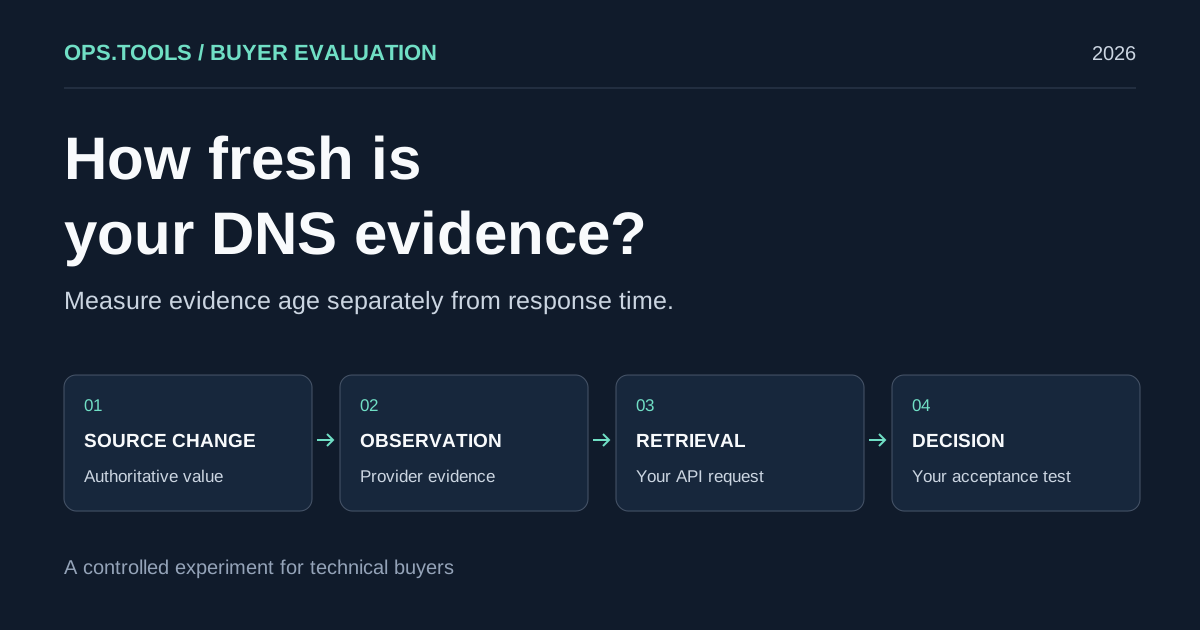
DNS API Data Freshness: A Buyer's Cache Evaluation Test
Evaluate DNS API data freshness with a controlled cache test, evidence timestamps, and buying criteria for release checks, domain audits, and security teams.
White-Label Domain Health APIs for MSPs: A Buyer’s Framework for 2026
Evaluate API-based DNS, WHOIS, IP, SSL, HTTP, and port evidence for branded MSP domain health services, bulk audits, usage controls, and client reporting.
API Usage Governance 2026: Control Credits, Keys, and Team Access Before You Scale
Evaluate domain and network API providers through API key controls, usage exports, credit governance, workflow ownership, bulk jobs, and alert-safe automation.