Infrastructure API POC Checklist 2026: API Keys, Usage Exports, Plan Fit, and Audit Evidence
A proof of concept should answer one hard question: can this API support the exact operating workflow your team wants to buy, without hiding cost, ownership, or alert routing problems until after procurement signs.
Why a POC Beats a Feature Checklist
Infrastructure API purchases often start as a simple comparison: DNS records here, WHOIS fields there, a certificate endpoint somewhere else. That comparison misses the real buying risk. The lookup may work, but the workflow can still fail because usage is hard to forecast, ownership is unclear, bulk jobs are brittle, or alert delivery depends on a native integration that was never documented.
The better evaluation is a short, realistic pilot. Use your own asset list. Include a few production domains, staging hosts, third-party vendor domains, IPs tied to known providers, and expired or nearly expiring certificates from a safe test environment. Then run the same checks your team expects to operate after the purchase.
This is bottom-funnel work. The goal is not to admire the docs. The goal is to produce a plan recommendation, a usage model, an exception list, and enough evidence for security, platform, finance, and procurement to make a decision without guessing.
Verified Ops.Tools Surface to Use in the Pilot
The live OpenAPI document lists a production server at https://api.ops.tools and documents API key authentication with the x-api-key header or query parameter. The same document lists external endpoint families for DNS lookup, WHOIS data, IP details, SSL checks, HTTP header analysis, port scanning, API key management, and usage reporting. Start with the API docs and the pricing page before building a scorecard.
Use those documented endpoints as the source of truth for a POC. Product pages may mention broader marketing capabilities. The pricing page also lists bulk validation, webhook notifications, usage logging controls, a TypeScript SDK, and a Postman collection. Treat those as evaluation items to verify inside the pilot, not as a reason to skip testing the actual workflow.
| POC check | Endpoint family | Decision it supports |
|---|---|---|
| Record validation | DNS lookup | Can release gates and audits trust the answer? |
| Registration intelligence | WHOIS data | Can domain owners track expiry and registrar drift? |
| Network ownership | IP details | Can security and SRE spot the wrong provider or ASN? |
| Certificate runway | SSL checker | Can the team prevent renewal and chain failures? |
| Web posture | HTTP analysis | Can reviewers see headers, redirects, and policy gaps? |
| Service exposure | Port scanner | Can public services be checked against an allowlist? |
Step-by-Step POC Workflow
- Pick one real workflow. Choose domain portfolio review, release validation, vendor intake, incident triage, or recurring infrastructure health checks. Do not test every possible use case at once.
- Create a representative manifest. Include domains, hostnames, known IPs, expected record types, expected owners, approved ports, criticality, and the team that will act on failures.
- Run the documented checks. Use the public API reference for DNS, WHOIS, IP, SSL, HTTP, and port results. Save raw JSON so the evaluation is repeatable.
- Measure exception quality. Count findings that are actionable, noisy, missing context, or blocked by unclear ownership. A cheap API is expensive if every result creates a meeting.
- Model usage against pricing. The pricing page uses one credit per request across DNS, WHOIS, IP, SSL, port scan, and related checks. Multiply normal runs, bulk audits, retries, and incident spikes before choosing subscription or credit packs.
- Verify alert paths accurately. If the workflow posts to Slack, Jira, PagerDuty, a SIEM, or a custom endpoint, describe it as your automation unless that exact native integration is documented.
- Export usage evidence. Use the usage endpoints and dashboard reporting to show finance and procurement what the pilot consumed.
Set Acceptance Criteria Before the First Call
A pilot without acceptance criteria turns into a demo. Write the pass conditions before engineering starts. That keeps sales calls, security review, and implementation work anchored to the same facts.
Good criteria describe observable behavior. For DNS record validation, define which record types matter and whether cached answers are acceptable. For WHOIS, define whether raw text is enough or parsed JSON is required. For SSL checks, define minimum days remaining, self-signed handling, chain expectations, and the certificate fields that must be visible in the ticket. For port checks, define the allowlist and the authorized targets.
| Pilot area | Acceptance test | Evidence to keep |
|---|---|---|
| Release validation | Known hostname resolves to an expected address or CDN target | DNS response, timestamp, record type, service owner |
| Domain portfolio | Parsed WHOIS output identifies expiry and registrar context | Raw WHOIS, parsed fields, renewal owner, criticality |
| Security review | Headers, TLS, and ports can be summarized without manual console work | Header summary, certificate state, port states, remediation owner |
Bulk Workflows Without Pretending Every Bulk Path Is Native
Bulk processing is where buyers learn whether a provider fits operations work. The pricing page lists bulk validation on paid plans, but the public OpenAPI reference exposes request-oriented endpoints. That means the POC should test both the product promise and your runner design: how a manifest fans out calls, how it handles partial failures, and how it records enough state to resume safely.
Do not score only a single perfect request. Run a batch that includes normal domains, parked domains, expired certificates in a safe test list, hostnames with no answer, and domains owned by vendors. If a result fails, the runner should preserve the target, endpoint family, HTTP status, error body if present, retry count, and owner. That makes the difference between a useful audit and a spreadsheet full of mystery blanks.
Pricing: Model the Workload, Not the Average Day
Ops.Tools pricing is explicit enough to model early: monthly plans start at $6.99/month, and the pricing page states that one credit equals one API request across DNS, WHOIS, IP, SSL, port scan, and related checks. It also lists pay-as-you-go credit packs. The exact plan choice should come from your pilot math, not from a generic request count.
Build three numbers: steady-state monitoring, scheduled bulk audits, and bursty incident or migration work. Steady-state monitoring tells you whether a monthly plan fits. Bulk audits tell you whether subscription credits, credit packs, or a higher tier make sense. Incident bursts tell you whether your alerts and retry policy can stay useful without creating surprise spend. If those numbers are not clear after the POC, the POC is not finished.
Security and Compliance Review Items
Security review should focus on the parts your team will operate. Confirm how API keys are created, stored, rotated, and scoped in your own environment. Confirm whether usage exports include enough detail for audit review. Confirm whether raw domain, IP, hostname, URL, and header values are acceptable under your data retention policy.
Compliance teams usually care less about the lookup itself and more about evidence quality. Can you show when a certificate was valid? Can you show the DNS answer before and after a release? Can you show which owner was notified when a vendor domain changed? If the answer is yes, the API has moved from a developer utility to an operational control.
What Not to Overvalue
Do not overvalue a long feature list if the POC cannot reproduce the workflow. Historical research, broad attack-surface search, managed monitoring, and native ticketing integrations can be valuable, but they answer different questions than current-state operational checks. If your purchase is meant to support release validation, renewal tracking, incident triage, or recurring infrastructure audits, score the vendor on those workflows first.
Also avoid treating AI or MCP support as a replacement for policy. Agent-discoverable docs and MCP transport metadata can reduce orchestration friction, but the buyer still has to define approved targets, allowed actions, escalation paths, and evidence retention. A controlled runner is useful. An unbounded agent with a production API key is not a procurement win.
Technical Implementation
Start with small, inspectable calls. The examples below use the base URL and header auth documented in the public OpenAPI file.
cURL: verify a DNS record with timing data
curl -G "https://api.ops.tools/v1-dns-lookup" \
  -H "x-api-key: $OPS_TOOLS_API_KEY" \
  --data-urlencode "address=app.example.com" \
  --data-urlencode "type=A" \
  --data-urlencode "getPerformanceData=true"
cURL: export pilot usage by service
curl -G "https://api.ops.tools/v1-get-api-usage" \
  -H "x-api-key: $OPS_TOOLS_API_KEY" \
  --data-urlencode "from=2026-05-01" \
  --data-urlencode "to=2026-05-20" \
  --data-urlencode "service=v1-dns-lookup"
TypeScript: score a pilot manifest
type Asset = {
  domain: string;
  expectedA?: string;
  approvedPorts: number[];
  owner: string;
};

const apiKey = process.env.OPS_TOOLS_API_KEY;
const baseUrl = "https://api.ops.tools";

async function getJson<T>(path: string, params: Record<string, string>) {
  const url = new URL(path, baseUrl);
  for (const [key, value] of Object.entries(params)) {
    url.searchParams.set(key, value);
  }

  const response = await fetch(url, {
    headers: { "x-api-key": String(apiKey) },
  });

  if (!response.ok) {
    throw new Error(`${path} failed with ${response.status}`);
  }

  return (await response.json()) as T;
}

export async function evaluateAsset(asset: Asset) {
  const dns = await getJson<{ records?: string[] }>("/v1-dns-lookup", {
    address: asset.domain,
    type: "A",
  });
  const ssl = await getJson<{ certificate?: { isValid?: boolean; daysRemaining?: number } }>("/v1-ssl-checker", {
    domain: asset.domain,
  });
  const ports = await getJson<{ summary?: { open: number } }>("/v1-port-scanner", {
    target: asset.domain,
    ports: asset.approvedPorts.join(","),
  });

  return {
    domain: asset.domain,
    owner: asset.owner,
    dnsMatches: asset.expectedA ? dns.records?.includes(asset.expectedA) === true : undefined,
    certificateValid: ssl.certificate?.isValid === true,
    certificateDaysRemaining: ssl.certificate?.daysRemaining,
    approvedOpenPorts: ports.summary?.open ?? 0,
  };
}
Commercial Decision Matrix
| Question | Good pilot evidence | Risk signal |
|---|---|---|
| Plan fit | Usage forecast maps cleanly to monthly credits or packs | Bulk audits require guesswork or hidden overage terms |
| Workflow fit | Exceptions route to owners with useful context | Results need manual cleanup before anyone can act |
| Security fit | API keys, usage logs, and evidence retention are clear | The pilot relies on shared keys or unmanaged scripts |
| Integration fit | Docs, OpenAPI, SDK, and webhook paths are verified | Sales claims outrun the public integration surface |
What to Put in the POC Readout
Keep the readout plain. List the use case, asset count, checks performed, services called, credits consumed, exception categories, unresolved gaps, and recommended plan. Include sample JSON for one clean pass and one failure. Add notes for internal automation: whether alerts are webhook-based, CI/CD-based, SIEM-based, or spreadsheet-driven.
If the buyer needs domain portfolio management, include expiration tracking and registrar review from WHOIS output. If the buyer needs incident response, include DNS, IP, ASN, certificate, header, and port evidence. If the buyer needs competitive research or domain data research, separate current-state checks from historical research needs so the team does not buy the wrong product category.
For manual validation during the pilot, keep the tool pages close: DNS lookup, WHOIS data, IP details, SSL checks, HTTP header analysis, and port scanning. For adjacent planning context, compare this checklist with the domain data buyer's guide, infrastructure cost model, and domain monitoring build-vs-buy guide.
FAQ
How long should an infrastructure API proof of concept run?
Run it long enough to cover the real workflow shape: a normal monitoring window, one bulk audit, one release validation, and one incident-style lookup burst. For many teams that is one to three weeks, but the useful measure is coverage of operating patterns rather than calendar time.
Should buyers test every endpoint before signing?
Test the endpoint families that map to the business workflow. For a domain operations program that usually means DNS records, WHOIS registration data, IP and ASN context, SSL certificate state, HTTP headers, and scoped port checks. Leave unrelated features out of the scorecard.
What should procurement ask engineering for after the POC?
Ask for a usage forecast, exception list, security review notes, plan recommendation, and evidence that the public API contract handled the real asset list. A clean POC should also show how failed checks reach owners through tickets, webhooks, or another internal automation path.
Is webhook support the same as a native integration?
No. A webhook is an integration primitive. If a vendor documents webhook notifications, you can use them for alerting workflows, but you should not describe that as a native Slack, PagerDuty, SIEM, or ticketing integration unless the vendor documents that specific integration.
Run a POC Against the Public API Surface
Use Ops.Tools for DNS, WHOIS, IP, SSL, HTTP, and port-check workflows with documented API key auth, usage reporting, and pricing that starts at $6.99/month.
Related articles
More guides from the same operational area.
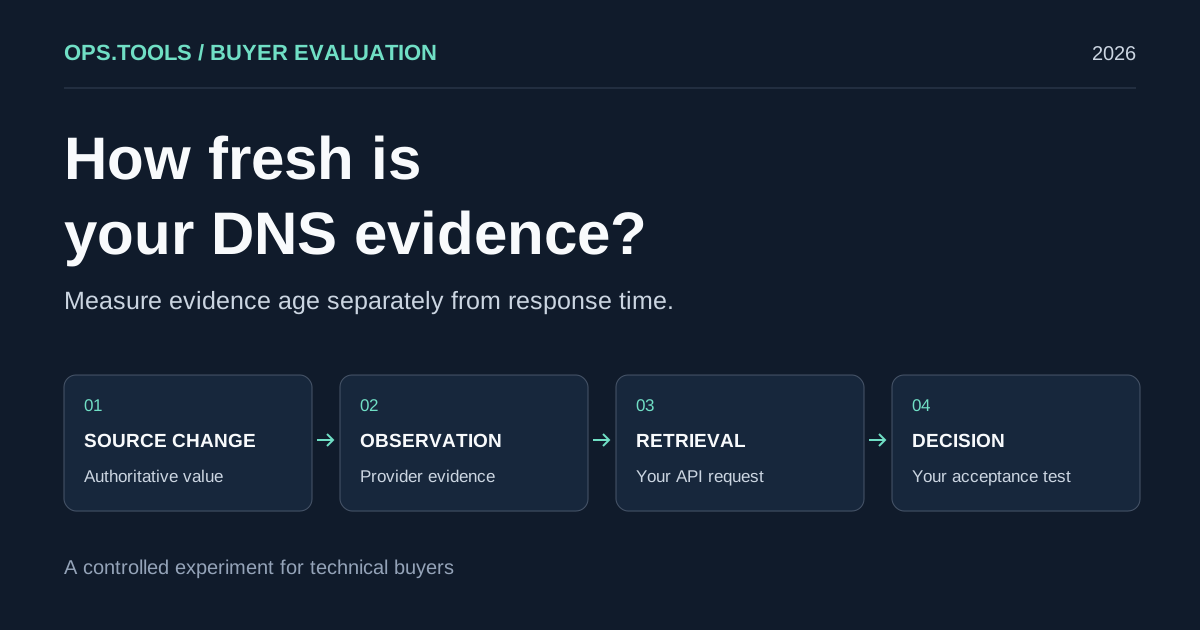
DNS API Data Freshness: A Buyer's Cache Evaluation Test
Evaluate DNS API data freshness with a controlled cache test, evidence timestamps, and buying criteria for release checks, domain audits, and security teams.
White-Label Domain Health APIs for MSPs: A Buyer’s Framework for 2026
Evaluate API-based DNS, WHOIS, IP, SSL, HTTP, and port evidence for branded MSP domain health services, bulk audits, usage controls, and client reporting.
API Usage Governance 2026: Control Credits, Keys, and Team Access Before You Scale
Evaluate domain and network API providers through API key controls, usage exports, credit governance, workflow ownership, bulk jobs, and alert-safe automation.