SecurityTrails Alternatives for Ops Teams in 2026: Pricing Visibility, Workflow Fit, and Verified Coverage
Most “alternative” searches start after the workload changes. Procurement wants public pricing. Platform teams need current-state checks they can wire into release guardrails. Security wants historical context. Nobody wants to bolt together five point tools without a clear owner.
How This Comparison Was Built
This comparison uses only what we could verify on public pricing pages, public docs, public product pages, and the current ops.tools repo and OpenAPI reference. That matters, because vendor comparison posts often flatten very different products into a fake apples-to-apples chart.
For ops.tools, the current public API reference documents six external endpoint families: DNS record lookup, WHOIS data, IP details, SSL checks, HTTP header analysis, and port scanning. The live site also has reverse IP and email-auth tool pages, but those capabilities are not listed in the current public OpenAPI file reviewed for this article, so they are excluded from the documented comparison matrix below. That kind of boundary discipline is the only way to keep a vendor-selection post useful.
The Fast Read: What Each Vendor Is Really For
| Vendor | What we verified | Best fit | Watch for |
|---|---|---|---|
| Ops.Tools | Public pricing table, public OpenAPI reference, and documented DNS, WHOIS, IP, SSL, HTTP, and port checks under one API surface | Current-state operational checks, release validation, domain due diligence, and unified monitoring workflows | Historical DNS and passive-DNS-style research are not documented in the public API reference reviewed here |
| SecurityTrails | Public docs for current and historical WHOIS, DNS data, and a SQL-like query interface for certain API endpoints | Historical research, attack-surface investigations, and teams that need search-first workflows | Public pricing was not surfaced on the official pages reviewed, and SQL API access is documented as sales-led |
| IPinfo | Public pricing plus product pages for IP geolocation, ASN, privacy, company, and hosted-domain data | IP enrichment, routing policy, geo controls, and fraud context | It is not a full DNS, WHOIS, certificate, and web-check operations stack on the reviewed pages |
| HackerTarget | Public browser tools and API access for GeoIP, DNS lookups, WHOIS, reverse IP, HTTP headers, traceroute, and port scanning | Tactical analyst work, security one-offs, and teams that want a broad tool belt quickly | Free API usage is rate-limited, output styles vary by tool, and governance workflows need more assembly |
| WhoisXML API | Public product pages for WHOIS API, DNS Lookup API, DNS Chronicle API, and IP Geolocation API | Teams that need broad domain-data coverage, historical DNS research, or product-by-product expansion | Product breadth is high, so buyers need to confirm which services and quotas are included in the specific plan under review |
Choose the Product Shape Before the Vendor
Ops teams usually fail vendor selection when they start with brand names instead of workflow shape. If your real job is pre-deploy validation, a research-heavy product with strong passive DNS history may still force you to buy or build a second tool for certificate and header checks. If your real job is threat hunting across old hosting records, a current-state checker will not replace historical search.
| Workflow | What matters most | Likely fit |
|---|---|---|
| Release validation | Current DNS state, certificate validity, header checks, predictable pricing, scriptable JSON output | Ops.Tools or a multi-tool stack you are willing to own |
| Domain portfolio monitoring | Registration intelligence, expiration tracking, bulk workflows, alert routing | Ops.Tools, WhoisXML API product mix, or a managed monitoring layer |
| Historical investigations | Historical WHOIS and DNS, search-first exploration, investigative breadth | SecurityTrails or WhoisXML API |
| IP-only enrichment | Geolocation, ASN, privacy signals, hosted domain context | IPinfo |
| Analyst tool belt | Lots of tactical checks, low friction, human-in-the-loop usage | HackerTarget |
Commercial Signals Buyers Should Score Explicitly
The real buying difference is often commercial shape, not endpoint syntax. Public pricing matters because it lets procurement model growth before a call. Public docs matter because platform teams can test output shape, auth, and edge behavior before legal review finishes. Workflow features matter because “good API data” still fails if you cannot batch checks or route findings to the systems your operators already use.
- Public pricing visibility: IPinfo and ops.tools both surface public pricing. HackerTarget publicly documents free limits and paid credit boosts. SecurityTrails pricing was not public on the official pages reviewed. WhoisXML API product pricing varies by service, so confirm the exact bundle under review.
- Documented scope: The ops.tools public API reference currently shows six operational checks. That makes it easier to wire a single evaluation harness for release, monitoring, and due diligence workflows.
- Alerting and automation: The current ops.tools pricing table lists webhook notifications and bulk validation. That matters more than glossy marketing when you need batched evidence and downstream routing.
- History versus current state: SecurityTrails and WhoisXML API stand out when the buyer needs historical DNS or WHOIS context. That is a different purchase than a current-state release gate.
Why Public Pricing Changes the Trial
Engineers usually say pricing is a procurement problem. In vendor evaluation, it is an engineering problem too. When the price table is public, a platform team can estimate what a month of release checks costs, a security team can model incident bursts, and a domain-ops team can see whether recurring renewal reviews fit a monthly tier or need overflow credits.
Sales-led pricing is not automatically bad. Some buyers do need custom support, private routing, or contract language a public self-serve plan cannot offer. The point is that public pricing reduces uncertainty during the proof-of-concept stage. If a team cannot estimate spend until the end of the buying cycle, the integration often gets approved on incomplete assumptions.
What Not to Force Into One Matrix
This is where a lot of comparison content goes soft. Historical research, tactical analyst tools, current-state release gates, and managed monitoring are not the same category just because they all mention domains or IPs. A product can be excellent for passive DNS or WHOIS history and still be the wrong fit for deployment validation. Another can be perfect for current-state checks and still not replace a deep investigative data platform.
Treat category mismatch as a legitimate conclusion. If the shortlist contains one product built for historical search and another built for operational guardrails, the answer may be “we need both” or “we need to decide which workflow matters more right now,” not “the broader marketing page wins.”
Run One Trial Harness Across Every Shortlist
A shortlist is only useful if every vendor is tested against the same workload. Pick a small but realistic list of production domains, vendor domains, and public endpoints. Measure output completeness, response shape, retry behavior, and how much cleanup work the integration requires. If a vendor hides core behavior behind a sales cycle, count that friction as part of the evaluation.
cURL: current-state checks on one domain
API="https://ops.tools/api"
KEY="$OPS_TOOLS_API_KEY"
DOMAIN="example.com"

curl -s "$API/v1-dns-lookup?address=$DOMAIN&type=MX&getPerformanceData=true" \
  -H "Authorization: Bearer $KEY"

curl -s "$API/v1-whois-data?domain=$DOMAIN&parseWhoisToJson=true" \
  -H "Authorization: Bearer $KEY"

curl -s "$API/v1-ssl-checker?domain=$DOMAIN&getPerformanceData=true" \
  -H "Authorization: Bearer $KEY"

curl -s "$API/v1-analyze-http?url=https://$DOMAIN" \
  -H "Authorization: Bearer $KEY"

curl -s "$API/v1-get-ip-details?ip=93.184.216.34" \
  -H "Authorization: Bearer $KEY"
TypeScript: score vendors against the same asset list
interface Asset {
  domain: string;
  expectedMx?: boolean;
}

interface Scorecard {
  domain: string;
  hasMx: boolean;
  registrar?: string;
  daysRemaining?: number;
  httpGrade?: string;
}

const API = 'https://ops.tools/api';
const headers = { Authorization: `Bearer ${process.env.OPS_TOOLS_API_KEY}` };

async function getJson<T>(path: string): Promise<T> {
  const response = await fetch(`${API}${path}`, { headers });
  if (!response.ok) throw new Error(`Trial request failed: ${response.status}`);
  return response.json() as Promise<T>;
}

async function evaluate(asset: Asset): Promise<Scorecard> {
  const dns = await getJson<{ records?: string[] }>(
    `/v1-dns-lookup?address=${asset.domain}&type=MX`,
  );
  const whois = await getJson<{ whoisJson?: { registrar?: string } }>(
    `/v1-whois-data?domain=${asset.domain}&parseWhoisToJson=true`,
  );
  const ssl = await getJson<{ certificate?: { daysRemaining?: number } }>(
    `/v1-ssl-checker?domain=${asset.domain}`,
  );
  const http = await getJson<{ summary?: { overallGrade?: string } }>(
    `/v1-analyze-http?url=${encodeURIComponent(`https://${asset.domain}`)}`,
  );

  return {
    domain: asset.domain,
    hasMx: (dns.records?.length ?? 0) > 0,
    registrar: whois.whoisJson?.registrar,
    daysRemaining: ssl.certificate?.daysRemaining,
    httpGrade: http.summary?.overallGrade,
  };
}
Mirror that same harness when you test competitors. The point is not to prove that one vendor wins on every metric. It is to make integration cost, documentation quality, and workflow fit visible before the contract stage.
Where Migration Work Usually Hides
Buyers often underestimate the migration in two places: data normalization and operational ownership. A research-first platform may return excellent context but still require a lot of glue code before a release or monitoring team can use it in a blocking decision. A tactical tool set may be easy for analysts but harder to standardize inside procurement-approved automation. A unified operational surface reduces that cleanup work, but only if the documented endpoints really cover the jobs you plan to automate.
That is why the shortlist should include one explicit question: “How much code do we own after the pilot?” If the answer includes lots of shape conversion, alert routing, or product stitching, count that as part of the total cost even when the endpoint price looks attractive.
Questions to Settle Before the Contract Stage
How much of our workload is current-state validation?
If the dominant job is release gating, vendor-domain due diligence, or ongoing configuration monitoring, optimize for a unified operational surface first and investigative depth second.
Do we actually need one platform?
Some teams do better with a split stack: one tool for historical research and another for operational checks. That can be the right answer as long as ownership and alert routing are explicit.
What happens when the workload bursts?
Rate limits and quota upgrades usually become visible during incidents, migrations, or acquisitions. Buyers should test the burst case, not just the quiet-week average.
What an Ops Team Should Actually Buy
If your team owns release guardrails, external checks, or vendor-domain intake, buy the platform that gives you the fewest moving parts for current-state validation. If your team spends more time reconstructing old hosting and registration history, buy the vendor that is strongest at historical search. If your need is mostly IP context, do not pay for a full domain-ops suite out of habit.
For ops.tools specifically, the strongest verified story is a unified operational surface for DNS, WHOIS, IP, SSL, HTTP, and port checks with public pricing, public docs, and API-first workflows. That makes it a better shortlist candidate for platform, infrastructure, and security operations teams than for buyers whose main priority is deep historical DNS research.
Three Internal Links Worth Opening Next
If you are already past the awareness stage and trying to choose or replace a vendor, these companion reads help tighten the decision:
- Domain Data API Buyer’s Guide 2026 for the broader evaluation framework.
- Infrastructure API Cost Modeling for monthly usage forecasting before procurement.
- Ops.Tools API reference to confirm the exact documented endpoint surface your team would integrate.
Compare With Your Real Workflow, Not a Marketing Grid
Use the public pricing table, the public API reference, and a small live domain set before you sign anything. That is where the real fit shows up.
Related articles
More guides from the same operational area.
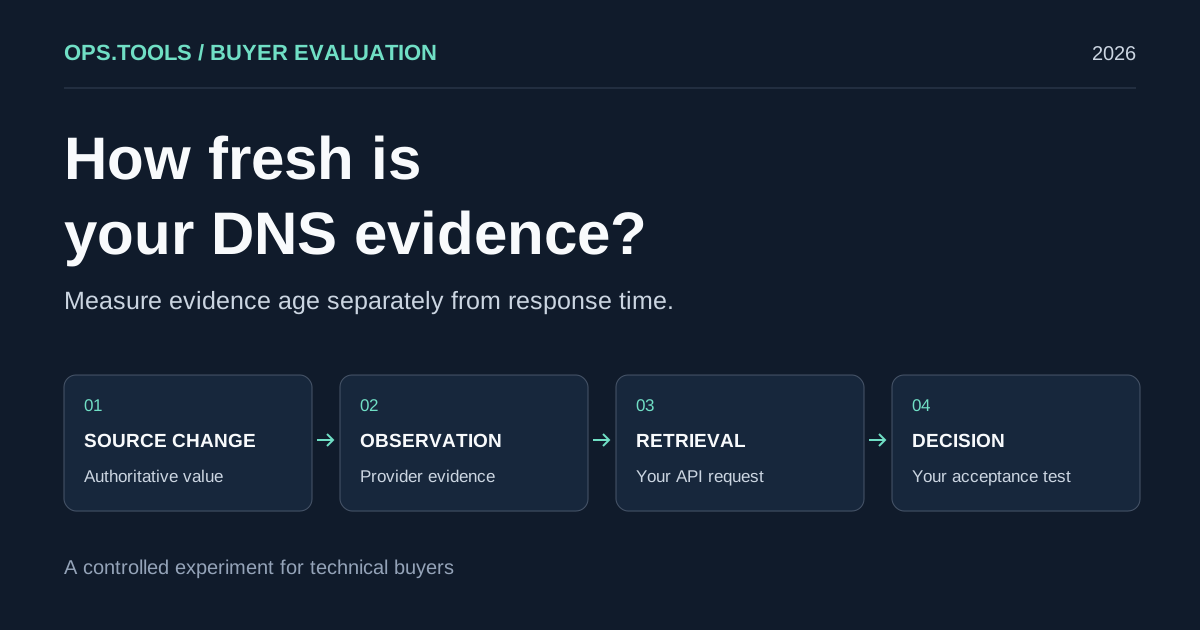
DNS API Data Freshness: A Buyer's Cache Evaluation Test
Evaluate DNS API data freshness with a controlled cache test, evidence timestamps, and buying criteria for release checks, domain audits, and security teams.
White-Label Domain Health APIs for MSPs: A Buyer’s Framework for 2026
Evaluate API-based DNS, WHOIS, IP, SSL, HTTP, and port evidence for branded MSP domain health services, bulk audits, usage controls, and client reporting.
API Usage Governance 2026: Control Credits, Keys, and Team Access Before You Scale
Evaluate domain and network API providers through API key controls, usage exports, credit governance, workflow ownership, bulk jobs, and alert-safe automation.